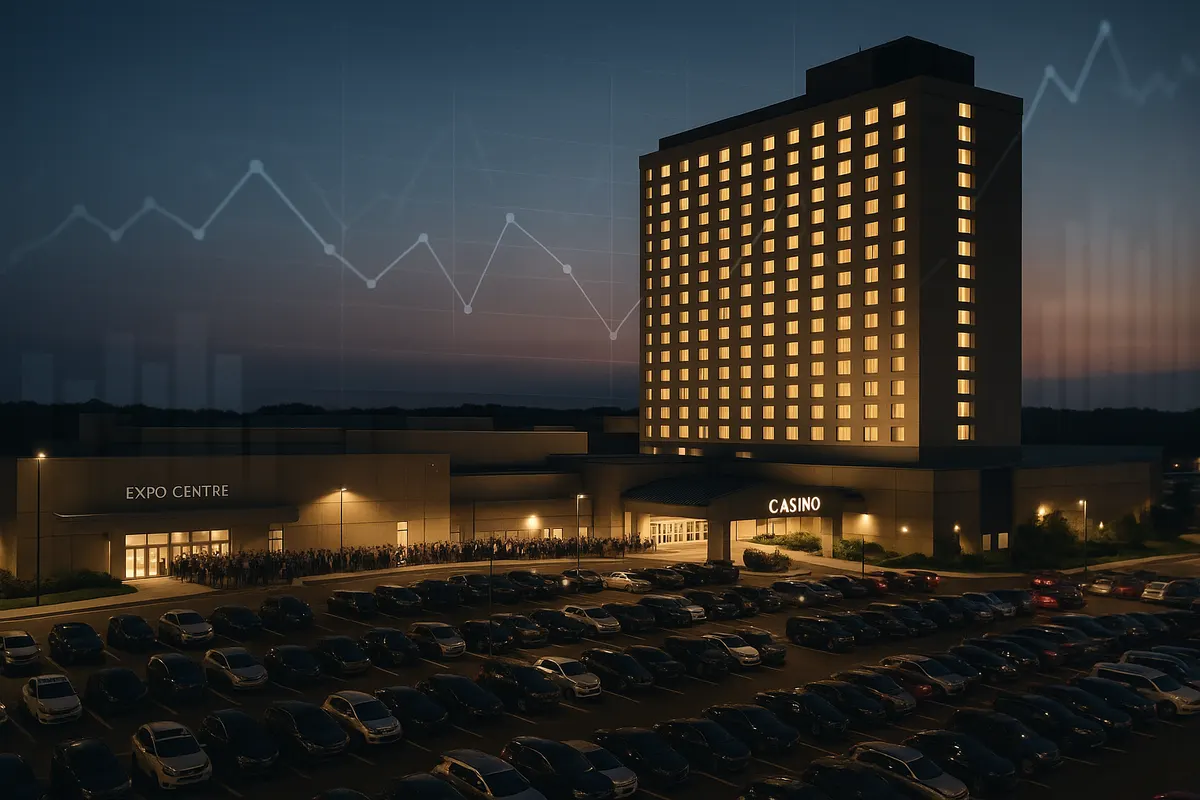
A 162-room hotel in central Nebraska saw its room bookings double off the back of a single announcement. No new advertising campaign, no rate promotion, no comped bus tours. Just the news that a sitting US president would be speaking at the expo centre directly across the road from Grand Island Casino Resort.
That is the cleanest illustration you will find of what the industry calls the celebrity bump. And it is also where most of the analysis goes wrong. A casino resort visitor boost tied to a one-off event almost never pays for itself on the night. It pays off, if it pays off at all, through customer acquisition: new names in the loyalty database, first-time trial of the property, and a cheaper cost per acquired player than the operator could buy through paid media. Judge these events on the till receipts for a single evening and you will usually conclude they were a waste of money. Judge them on database growth and 90-day repeat visitation and the maths looks very different.
The business case for celebrity casino visits
Casinos court high-profile guests, political rallies, concert headliners and sports teams because a regional property’s core constraint is not margin. It is reach. Slot floors and hotel rooms are fixed-cost assets. Once the doors are open, the marginal cost of serving one more visitor is small, so the whole business model rests on pulling more qualified people through the doors more often.
Direct revenue streams from a high-traffic event are straightforward:
- Gaming — slot and table handle from incremental visitors, plus sportsbook wagers from a crowd that is already in a social, event-day mood.
- Rooms — occupancy and average daily rate both rise when an event compresses demand into one or two nights, and rate is where the real upside sits.
- Food and beverage — the most reliable spike of the lot, because everyone eats, including the large share of event attendees who never place a bet.
- Retail, spa and parking — small in absolute terms, but high-margin and easy to flex.
The indirect benefits are harder to bank and are usually the real reason the general manager says yes. Regional and national press name the property in coverage it would never otherwise appear in. The venue gets positioned as a destination rather than a slots barn. And crucially, thousands of people who live within a two-hour drive form a first impression of a building they had only seen from the highway. For a property that opened recently, that trial value is the whole point of modern casino marketing strategies.
Measuring a casino resort visitor boost: the metrics that matter
Serious operators do not measure these events by headcount. They measure them with a small set of numbers, each on a different clock.
| Metric | What it tells you | When it shows up |
|---|---|---|
| New loyalty card enrolments | Size of the acquired audience, the single most important output | Event day |
| Carded gaming revenue vs. same-day baseline | Whether incremental visitors actually gambled | Event day |
| Theoretical win per visitor | Quality of the crowd, not just its size | Event day to 7 days |
| Occupancy and ADR uplift | Whether the room block was sold at rate or discounted to fill | Booking window to event |
| F&B covers and average check | Non-gaming capture of a non-gambling crowd | Event day |
| Second-visit rate of new enrolments | Whether the bump became a customer | 30 to 90 days |
| Cost per acquired active player | The actual ROI figure | 90 to 180 days |
The pair that decides everything is the last two. An event that enrols 2,000 new cards and converts 8% of them into repeat visitors has done more for the business than an event that triples a single Monday’s handle and leaves nothing behind. Uncarded cash play on event day is real money, but it is anonymous money, and anonymous money cannot be remarketed.
Grand Island: a $185 million asset and a free billboard
Elite Casino Resorts opened Grand Island Casino Resort at Fonner Park in April 2025, in partnership with the Hall County Livestock Improvement Association. The $185 million property runs a 37,000-square-foot casino with roughly 750 slot machines, 20 table games, a poker room and a sportsbook, alongside a 162-room hotel, three restaurants and bars, indoor and outdoor pools, and a spa and fitness centre.
When President Donald Trump was scheduled to speak at the Pinnacle Bank Expo Center, which Fonner Park owns and which sits directly across from the casino, general manager Vince Fiala told local broadcaster KSNB that room numbers had doubled since the announcement and that he expected a full house, with visitors arriving from across the state and beyond. It was the first visit from a sitting president to Grand Island since George W. Bush in 2006.
Now run the numbers honestly. Through August, Grand Island won a little over $44 million from slots, tables and sports betting, placing it third among Nebraska’s five racetrack casinos. Over roughly its first five months of operation, that averages out to about $290,000 of gross gaming revenue per day.
| Nebraska racetrack casino | GGR through August |
|---|---|
| WarHorse Casino Omaha | $80.5 million |
| WarHorse Casino Lincoln | $63.5 million |
| Grand Island Casino Resort | Just over $44 million |
Even a spectacular event night — say gaming revenue running 50% above the daily average — adds something in the region of $145,000 of GGR. A sold-out 162-room hotel at a $150 average daily rate is roughly $24,000 of room revenue; that rate is illustrative arithmetic, not a published figure, but the order of magnitude holds. Add a strong day in three restaurants and you are still looking at a sum that barely moves the annual line.
Which is precisely why the event is worth doing. Nobody at Elite Casino Resorts is banking the one-night till. They are banking several thousand Nebraskans walking into a five-month-old building, eating there, seeing the spa and the poker room, and taking a players card. Against a $185 million capital investment in a market where two larger competitors already hold the top two GGR positions, cheap trial at scale is the asset being acquired.
How media value gets calculated, and why to discount it
Marketing teams routinely attach a dollar figure to coverage using advertising value equivalency: estimate the audience reached, apply a cost per thousand impressions, and report the total as earned media value. It is useful for scale comparison and nearly worthless as a profit measure.
Three reasons to haircut any such number heavily. Editorial mentions are not brand-controlled, so the property might be a geographic reference rather than a destination recommendation. Reach is not intent; a reader in another state is not a prospective visitor for a regional casino with a drive-time catchment. And coverage of a political event is coverage of the politics, with the venue as scenery. A sober version of the calculation counts only impressions inside the property’s actual market radius, and treats the rest as zero.
Event-driven demand versus sustainable growth
Event-driven gambling demand has a signature shape: a sharp single-day spike, a slight hangover the day after as regulars avoid the crowds, then a return to baseline within a week. If nothing else happens, that is the entire story.
Conversion is an operational discipline, not a consequence. The properties that turn a crowd into customers do unglamorous things on the day:
- Staff the enrolment desks like a casino floor, not a cloakroom. Tablet-based sign-ups at entrances and restaurant queues, not one podium near the cage.
- Make the first offer a return offer. Free play or an F&B credit dated for the following month gives a measurable reason to come back and a clean attribution trail.
- Protect the regulars. Core players generate the predictable revenue. Lose them to a weekend of parking chaos and queues and the event can be net negative.
- Price the rooms properly. Doubling bookings at a discounted rate converts scarce inventory into low-yield business and crowds out higher-value guests.
- Tag everything. Event-day enrolments need a source code so the 90-day repeat rate can actually be read.
Repeat visitation is the only number that distinguishes publicity from profit. Buzz is a one-day spike in traffic. Profit impact is a measurable lift in the active player count that is still visible a quarter later.
The cost side, and what the ROI calculation really looks like
The bill for a large event rarely appears in a single line item, which is how operators talk themselves into overspending. The categories to model are consistent across properties: incremental security and crowd management, overtime and extra shifts across floor, housekeeping and kitchen, parking and shuttle logistics, inventory build for restaurants and bars, complimentary rooms and hospitality, promotional free play, local advertising to piggyback on the attention, and the opportunity cost of displaced higher-yield business. Published figures for any specific event are not generally disclosed, so treat these as the structure of the cost model rather than a priced-out budget.
The honest ROI question is not “did we make money on Monday”. It is this: incremental gross margin from the event, plus the estimated lifetime value of newly acquired active players, minus total event cost, compared against what the same spend would have produced through the property’s normal direct mail, digital and free-play channels. If an event delivers acquired players at a lower cost than the house channels, it was good marketing. If not, it was a good night out that happened in your building.
What makes one high-profile visit more valuable than another
Not all attention is equal, and the variables are predictable:
- Audience overlap with the gaming demographic. A crowd that matches the property’s core player profile converts. A crowd that does not simply eats and leaves.
- Geographic proximity. Regional casinos live on drive-time repeat business. Attendees from inside the catchment are prospects; everyone else is a one-night transaction.
- Physical adjacency. Grand Island’s advantage is that the expo centre is across the road. Capture rates collapse with every extra mile between the event and the floor.
- Dwell time. Events that create hours of waiting before or after push people into restaurants, bars and the casino floor. Drop-in-and-out events do not.
- Repeatability. A venue relationship that delivers events every month compounds. A once-in-two-decades visit is a story, not a strategy.
- Brand fit. Coverage that frames the property as a resort destination is worth more than a mention that frames it as a car park.
The first presidential visit to a town in nearly 20 years scores well on adjacency, dwell time and local audience, and poorly on repeatability. That is a reasonable trade for a property still building awareness in its first year. It would be a thin return for a mature property with an established database.
FAQ
How do celebrity visits boost casino revenue?
Through four streams on the day — gaming handle, hotel rooms at higher rates, food and beverage, and ancillary spend such as retail and parking — plus acquisition value from new loyalty sign-ups and earned media. The day-of revenue is usually small relative to annual totals; the acquisition value is where the case is made.
What is the “Trump bump” effect?
It is shorthand for the traffic and bookings surge a venue sees around a high-profile political appearance. At Grand Island Casino Resort, management reported hotel bookings doubling after the visit was announced, with a full house expected on the night.
Do high-profile events increase casino profits?
They increase revenue for a day or two reliably. Whether they increase profit depends on event costs, displaced regular business, and how many new visitors return within 90 days. Plenty of well-attended events are gross-revenue positive and contribution-margin negative.
How much revenue do casino events generate?
It scales with property size. Using Grand Island as a reference point, a venue averaging roughly $290,000 in daily gross gaming revenue might add a six-figure sum across gaming, rooms and dining on a strong event day. Operators treat that as a bonus and the database growth as the real return.
One closing note on the marketing side of this. Acquisition campaigns built on event-day sign-ups put a lot of first-time visitors into a database, and responsible operators pair that with deposit and loss limits, self-exclusion options and clear information on the house edge. Gambling carries a built-in mathematical advantage for the operator and should be treated as entertainment spending, never as income. Services such as the National Council on Problem Gambling provide free, confidential support.