
What native AI in online casinos actually means
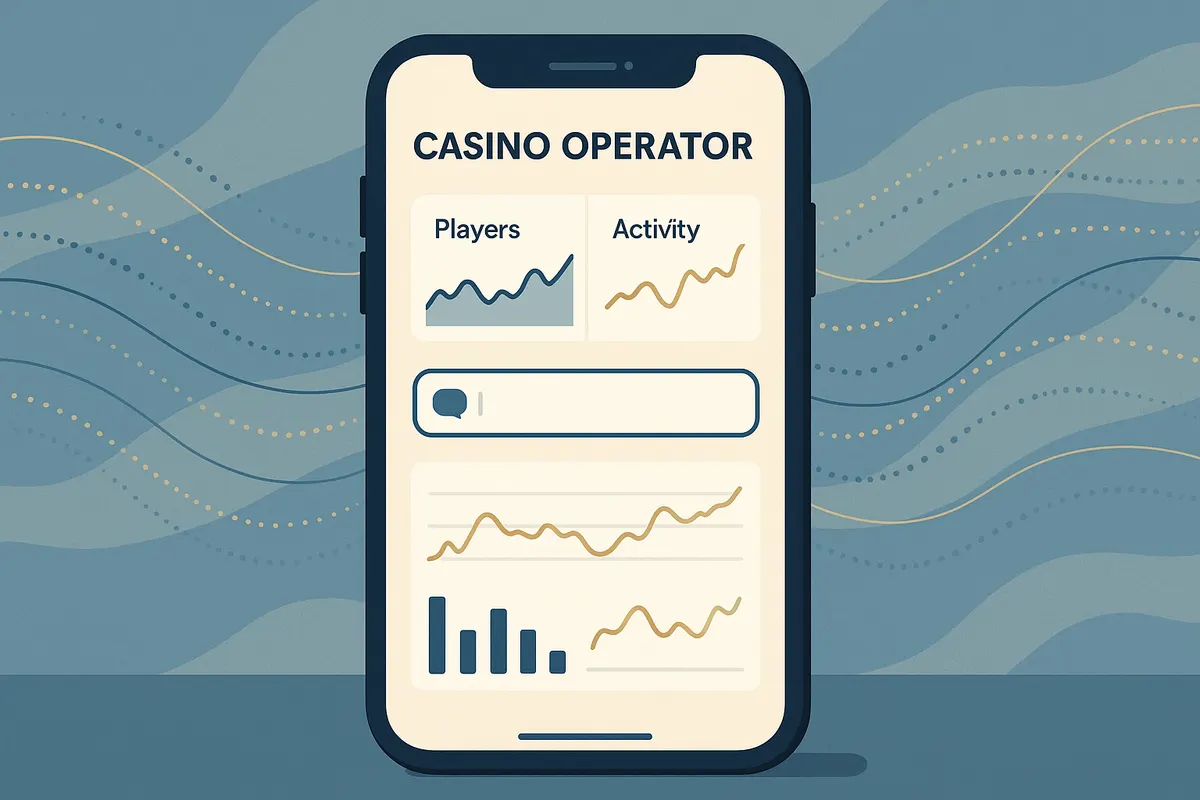
A CRM manager opens her phone on a Monday morning, asks why a weekend free-spins campaign underdelivered in one market, gets the segment breakdown, rewrites the audience rule, and approves the new version before she reaches the office. No report request, no meeting, no laptop. That workflow is what Fast Track shipped when it launched a native Fast Track AI app for iPhone, available on the App Store, extending a platform that has been running since its 2025 launch.
That is one small, concrete slice of AI in online casinos. The bigger picture matters more to you as a player: the same class of system that writes marketing campaigns is also the one scoring your session for signs of gambling harm, deciding which slot appears first on your lobby, and flagging your withdrawal for a second look. Here is how it works, in the order it touches your account, and what to check.
Native AI is built into the casino platform itself, with direct access to live player data, the same user permissions, and the same audit trail as the rest of the system. External AI is a separate tool bolted on afterwards, usually fed exported data on a delay.
The distinction is not marketing noise. It decides whether a system can act in real time or only report after the fact, and it decides who can see what.
Built-in vs bolted-on systems
| Factor | Native AI | External / third-party AI |
|---|---|---|
| Data access | Live platform data | Exported or batched data |
| Speed | Real time, mid-session | Hours to days |
| Permissions | Inherits platform roles | Separate access rules |
| Audit trail | Logged with platform actions | Often fragmented |
| Main risk | Deep access to everything | Data leaving the platform |
Fast Track’s native AI app as a working example
Fast Track, a Malta-based CRM services company for iGaming operators, says its iPhone app carries the full capabilities of Fast Track AI: asking about weekend market performance, checking site performance, reviewing player activity, examining specific campaign results, then designing, modifying and approving campaigns from the phone.
CTO Patrik Potocki made the engineering point plainly: “Fast Track AI on a phone has to meet the same standard as the platform itself: the same real-time data, the same permissions and the same audit trail.” He added that it was built as a native app rather than a wrapper around the web product. Co-founder and CEO Simon Lidzén framed the goal as making AI part of everyday decisions rather than a separate reporting exercise.
Read that through a player’s eyes and the message is simple: commercial decisions about your account can now be made faster, by more people, from anywhere.
How casino personalization works, step by step
Casino personalization is pattern matching on behavior. The system records what you play, how long, at what stake, at what time of day, on which device, and then predicts what you are likely to do next. Three outputs follow.
Smart game recommendations
Machine learning models group players by similarity, the same collaborative filtering idea streaming services use. If you mostly play high volatility slots in short bursts and occasionally drop into a live Teen Patti table, your lobby reorders itself around those two clusters. A new release with similar volatility and theme gets pushed to the top row.
Worth being clear about what this does not do. Recommendations change what you see, not the math of what you play. RTP and volatility are fixed in the game build and the outcomes come from a certified RNG. No recommendation engine makes a 96% RTP slot pay more or less for you than for anyone else.
Personalized bonus offers
Predictive analytics estimate your likely value and your likely churn. A player who has not logged in for ten days gets a reactivation offer; a steady low stake player gets free spins on a game they already play; a high roller gets cashback. The offer is targeted, but the terms still bite. A 30x wagering requirement on a ₹1,000 bonus means ₹30,000 must be wagered before withdrawal, and game weighting decides how fast that clears. Personalization makes offers more relevant, not more generous.
Adaptive user interfaces
Layouts, banner placement, payment method ordering and even notification timing adjust per segment. UPI tends to float to the top for Indian players because conversion data says so. Push notifications land when your historical session start time says you are likely to open the app. That last one deserves scrutiny, because the line between convenience and nudging a habit is thin, and it is drawn by whoever configures the campaign.
Responsible gaming technology: what the models watch for
This is where real-time monitoring earns its keep. Instead of waiting for a player to self-report a problem, behavioral analysis scores each session against markers of harm as it happens.
Behavioral pattern detection
Commonly used markers across regulated markets include sharp stake escalation, sessions running far longer than a player’s own baseline, repeated failed deposits, late-night play spikes, and deposits immediately after heavy losses, the classic chasing pattern. The strength of a model is that it compares you to your own history, not an arbitrary average.
| Marker of harm | What the system sees | Typical response |
|---|---|---|
| Stake escalation | Average bet multiplying within one session | On-screen reality check |
| Loss chasing | Deposit within minutes of a losing run | Deposit cool-off prompt |
| Session creep | Play time well above personal baseline | Time and spend reminder |
| Payment stress | Multiple declined deposits | Human review, limit prompt |
| Multiple flags | Several markers in a short window | Account review, marketing suppression |
Automated risk interventions
Interventions escalate. A reality check pops up mid-session. Then a prompt to set a deposit or loss limit. Then removal from promotional lists, so the player is not being emailed offers while flagged. At the top end, a temporary block pending a conversation with a human. A well-built system treats automation as triage, not as a final decision, because a false positive that locks an account is a real cost and a false negative is a real harm.
Regulatory compliance support
Supervisors in mature markets expect operators to show evidence that they identified a struggling customer and did something about it. An audit trail that records the flag, the intervention and the timestamp is far easier to defend than a manager’s recollection. That is why the audit trail language in Fast Track’s announcement is not a throwaway line; it is the compliance product.
None of this replaces your own controls. Deposit limits, loss limits, session limits, cool-off and self-exclusion sit in your account settings and work whether or not an algorithm has noticed anything. Our guide to responsible gambling tools walks through setting them.
Where iGaming automation saves the operator money
Most AI spend in the industry is not glamorous. It is cost per ticket and chargeback ratios.
- Support automation. Industry estimates for iGaming put the share of customer inquiries chatbots and AI can handle autonomously at roughly 70 to 80 percent, mostly KYC status, withdrawal timing and bonus terms, with the rest routed to agents with the account history already attached. Faster answers for you, fewer agents for them.
- Fraud detection. Risk assessment models catch bonus abuse across linked accounts, device and IP mismatches, payment patterns consistent with money laundering, and collusion in live card games. The honest downside: legitimate players sometimes get caught and have to re-verify.
- Marketing optimization. CRM automation runs continuous tests on timing, channel and creative, and predicts which segment responds to what. This is the territory Fast Track’s AI app occupies.
The efficiency gain is real and it cuts both ways. Better targeting of a reactivation email is also better targeting of a player who would be healthier left alone, which is exactly why marketing suppression rules and responsible gaming flags need to run on the same data.
The uncomfortable part: player data, AI and fairness
What actually gets collected
Assume the platform holds your KYC documents, deposit and withdrawal history, every bet and its timestamp, session lengths, device and browser fingerprints, approximate location, clicks inside the lobby, support chat transcripts, and email open behavior. Native AI makes that pile queryable in plain language, which is a genuine privacy shift: the barrier to someone asking a detailed question about one player drops to almost nothing. Permissions and logging are the only thing standing in the gap.
Algorithmic fairness challenges
Models learn from past data, so they inherit its skew. If historical data over-represents one type of player, offer eligibility, risk scoring and verification friction can end up unevenly distributed without anyone intending it. Two fairness questions deserve straight answers from operators: are responsible gaming models tuned to protect players or to protect revenue, and is there a human in the loop when a model restricts an account? Game fairness itself is a separate matter, governed by RNG certification and published RTP, and it is not affected by the CRM layer.
Oversight for the Indian market
India’s Digital Personal Data Protection Act, 2023 sets out consent, purpose limitation and data principal rights, which is the relevant frame for anything a platform does with your behavioral data. On gambling itself, the position changed in August 2025: the Promotion and Regulation of Online Gaming Act, 2025 imposes a nationwide ban on all real-money online gaming in India, superseding the earlier patchwork of differing state-level rules, including the prior bans in states such as Telangana and Andhra Pradesh. The prohibition is now a uniform national one rather than something that varies by state, so check the current legal position before depositing anywhere. Practical reality: many offshore platforms serving Indian players sit outside Indian supervision, which means any AI-driven player protection they run is voluntary, not enforced. See our notes on protecting your data on gambling sites for the checks worth doing.
A five-minute audit of your own account
- Open your account settings and set a deposit limit and a session limit now, before you need them.
- Find the privacy policy and search it for “profiling”, “automated” and “third party”. If those words are absent, treat the policy as incomplete.
- Switch off promotional push notifications and email if offers are shaping when you play.
- Check the licence on the footer and whether its regulator publishes player protection rules you can read.
- Look up the RTP of the games in your “recommended for you” row. A personalized lobby is not a better-paying lobby.
Where AI in online casinos goes next for Indian players
Expect three shifts. Conversational interfaces will move from the operator’s back office to the player-facing side, so lobby search and support start to feel like asking a question instead of browsing menus. Responsible gaming models will get more granular, and in regulated markets they will increasingly be audited rather than taken on trust. And data rules, not gambling rules, will do a lot of the work: consent, retention and profiling obligations apply to a casino’s machine learning stack the same way they apply to a retailer’s.
The sober read is that AI in online casinos mostly makes an existing business faster. It does not change the house edge, it does not make any game more likely to pay, and a slicker interface is not a safer one. Treat the personalization as convenience, use the limits, and if gambling stops being entertainment, use self-exclusion and contact a support service. Play only if you are of legal age in your jurisdiction.
FAQ
What is native AI in casinos?
AI built directly into the casino platform, sharing its live data, user permissions and audit trail, rather than a separate tool fed exported data later. Fast Track’s AI app is an operator-side example: full platform capability on a phone, built natively instead of wrapped around a web page.
How does AI personalize the casino experience?
By analyzing your play history, stakes, timing and device, then reordering the lobby, selecting bonus offers and adjusting the interface for your segment. It changes what you see, never the RTP or RNG outcome of the games.
Can AI detect problem gambling?
It can detect patterns associated with harm, such as stake escalation, loss chasing and unusually long sessions, and trigger reminders, limit prompts or account review. It is a screening tool, not a diagnosis, and it works best alongside limits you set yourself.
What data privacy risks come with casino AI?
Broad behavioral profiling, long retention, sharing with marketing partners, and the lower effort needed to query an individual player’s record. Under India’s DPDP Act, 2023 you have rights over that data, but enforcement is harder against platforms based outside Indian jurisdiction.