The five minutes after a betting app goes dark
A punter in Belo Horizonte opens his sportsbook twenty minutes before kickoff. The app loads a notice instead of a bet slip. He does not shrug and go read a book. He types the brand name into a search bar, finds a lookalike domain, deposits with a QR code, and places the bet he was always going to place. Total elapsed time: about five minutes.
That small scene is the whole argument about the Brazil betting ban in miniature, and it’s why the subject dominated conversation at SBC Summit Lisbon 2026 rather than sitting quietly in a legal newsletter. A ban removes supply. It does not remove demand. The gap between the two gets filled by whoever is willing to operate outside the rules, and those operators are not running age checks, deposit limits, or a complaints desk.
Brazil’s starting point: a market that had only just been licensed
Context matters here, because Brazil was not a prohibition market that suddenly cracked open. It was the opposite: a huge grey market that had just been brought inside a rulebook.
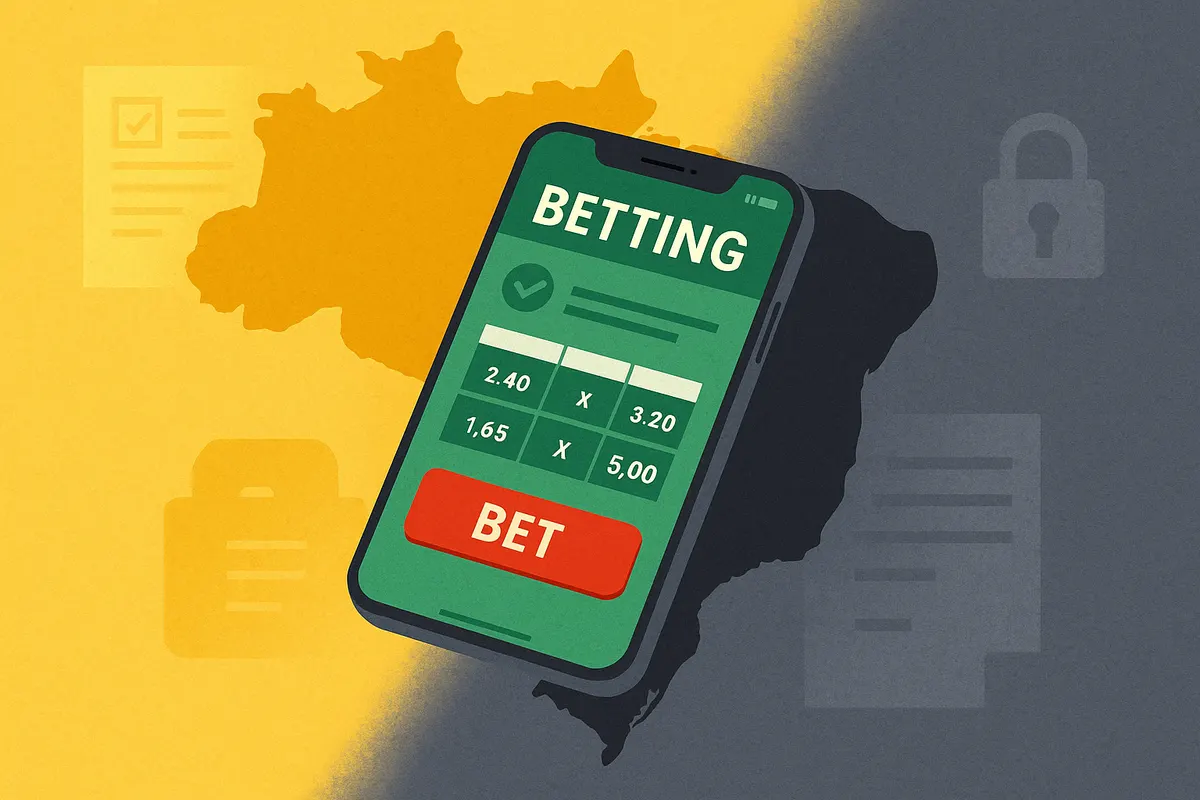
Law 14.790, passed at the end of 2023, created a federal framework for fixed-odds betting and online casino. The regulated market went live at the start of 2025 under the Ministry of Finance’s prizes and betting secretariat (SPA). The terms were not cheap or casual:
- A federal licence costs R$30 million for five years and covers up to three brands.
- Operators pay 12% of gross gaming revenue, plus the usual corporate taxes.
- Players owe 15% income tax on net winnings.
- Authorised sites must run on the .bet.br domain, so a legal operator is identifiable from the address bar alone.
That last detail is the most useful piece of consumer protection Brazil built, and it’s also what makes any sudden restriction so consequential. When a market has spent money and effort teaching people “look for .bet.br”, a blocked or banned legal product sends traffic straight back to the .com mirrors that the regime was designed to displace. Enforcement in Brazil has leaned on domain blocking with the telecoms regulator and on payment restrictions, and both are slow relative to how fast a new mirror site appears.
The scope of the measure debated in Lisbon was still moving, and reasonable people in the room disagreed about how much of the market it would ultimately touch. The mechanics below hold regardless of where that lands. For the conference reporting itself, see SBC News coverage of SBC Summit Lisbon 2026.
Three ways a government can handle betting demand
Strip away the politics and there are really three policy options. They produce very different outcomes for the same population of players.
1. Outright prohibition
Ban the activity and pursue operators. On paper, zero gambling harm. In practice, demand moves to offshore sites, Telegram bookmakers, and local agents. Tax revenue goes to zero, the state loses its data, and nobody is counted. Prohibition works best where demand is genuinely small and payment rails are tightly controlled. Neither is true of a football-obsessed market with instant bank transfers in every pocket.
2. Partial bans and heavy restriction
Keep the market legal but strip out the parts regulators dislike: certain products, certain payment methods, advertising, bonuses, high stake limits. This is the most common choice and the most delicate one. Restrictions aimed at harm can work, but each one widens the feature gap between the licensed product and the unlicensed one. If the illegal site offers the same match, bigger limits, a 200% bonus, and no tax on winnings, “legal but worse” is a weak sell.
3. Regulation plus real enforcement
Licence a competitive number of operators, tax at a rate they can survive, and spend the proceeds on blocking, payment interdiction, advertising enforcement, and public education. Unglamorous, and the only one of the three that reliably moves players from unlicensed sites to supervised ones.
The verdict the industry reached in Lisbon was not subtle, and it isn’t self-serving to state it plainly: option three is the only one that improves player safety, because it’s the only one where a regulator still has leverage over the operator holding a player’s money.
What a player actually trades away on an unlicensed site
This is the part most coverage skips. “Illegal betting sites” sounds like a legal abstraction until you compare the two experiences line by line.
| Protection | Licensed .bet.br operator | Unlicensed site |
|---|---|---|
| Age and identity checks | KYC required before play and withdrawal | Often an email address and nothing more |
| Withdrawals | Enforceable, with a regulator to complain to | Discretionary; accounts can be voided or closed |
| Deposit and loss limits | Mandated tools, self-exclusion available | Rarely offered, never audited |
| Game fairness | Certified RNG and tested RTP | Unverified software, sometimes cloned |
| Dispute resolution | Regulator and consumer law | A support chat with no obligations |
| Data and payments | Regulated processors, audited handling | Unknown recipients, chargeback exposure |
| Tax position | Clear rules on net winnings | Undeclared funds, bank scrutiny risk |
None of this changes the underlying maths. Every game still carries a house edge, and a 96% RTP slot is a 96% RTP slot on either site, assuming the unlicensed one hasn’t tampered with it. The difference is that on a licensed site you lose what the odds say you lose, and you can get your balance out. On an unlicensed one you carry counterparty risk on top of the house edge.
Channelisation is the number worth arguing about
Channelisation is the share of total betting activity that happens with licensed operators. It is the single metric that tells you whether a gambling regulation regime is working, and it’s the metric a ban attacks from the wrong end.
Push channelisation down and three things follow, in order. First, harm becomes invisible, because unlicensed operators don’t report anything and don’t honour self-exclusion. Second, tax receipts fall, which shrinks the enforcement budget that was supposed to fix the problem. Third, the licensed operators left standing face a competitor with no compliance cost, which makes the licence itself look like a bad deal. That is how a market slides backwards, and it is much harder to reverse than it was to cause. Mirror domains cost a few dollars; licences cost R$30 million.
What this means in practice
If you work in the industry, the Brazil episode is a reminder that regulatory risk is now a product question, not just a legal one. Payment redundancy, domain strategy, and clear licence signalling in your branding are what keep legitimate traffic from drifting to mirrors when something breaks. Affiliates carry real responsibility here too: sending traffic to an unlicensed operator because the terms look better is how the drift starts, and in a licensed market it is also a compliance problem with your name on it.
If you’re a player, the practical rule in Brazil is the boring one: check the address bar for .bet.br, and treat a brand that suddenly reappears on a .com or .net domain as a stranger rather than an old friend. Across any regulated market, the equivalent test is whether the site names its licence and whether that licence actually covers you.
And the point that survives whichever way Brazil’s rules settle: bans relocate gambling, they don’t end it. Betting is entertainment with a negative expected return, so stake only what you can afford to lose, use deposit and session limits, and if play stops feeling like a choice, self-exclusion tools and national support services exist for exactly that reason.
Common questions
Does a betting ban reduce gambling?
It reduces legal gambling, which is not the same thing. Where demand and easy payments exist, activity moves offshore. The measurable effect usually shows up as falling channelisation and falling tax revenue rather than falling play.
Why would anyone choose an unlicensed site?
Because it’s often more generous on the surface: bigger bonuses, no verification, no tax, no limits. Those are the exact features a regulator removes, which is why licensed products need to compete on trust, speed of payout, and reliability instead.
What makes enforcement work?
Domain blocking and payment blocking together, applied continuously rather than in occasional sweeps, plus advertising enforcement so unlicensed brands can’t buy visibility. Enforcement is funded by a taxed legal market, which is why the tax rate and the licence cost are player-safety questions, not just fiscal ones.